
Searching Clay County Criminal Dockets
Missouri Case.net is the state's official public case-information system. With a case number in hand, use Case Number Search. Type the number exactly as written, keeping every letter, the year, the hyphens, and any leading zeroes, and pick Clay County or the 7th Judicial Circuit if the portal offers that choice. No case number? Litigant Name Search can still pull up public matches. Before opening a docket, check the legal name against the case header, the filing year, the case type, and the division. Filing Date Search works well when you know a narrow window for a new filing. For a hearing that has not happened yet, Scheduled Hearings & Trials Search is the right tool. The live portal may change its filters, so trust the screen in front of you over any description of it. Remember that a case search is a public-information route. It is not a request for a certified record.
| Need | Official route | Clay County caution |
|---|---|---|
| Known file | Case Number Search | A transferred municipal matter may carry a new number. |
| Unknown number | Litigant Name Search | Protected parties may not appear by name. |
| Future setting | Scheduled Hearings | Scheduled does not mean completed. |
Clay County Criminal Docket Fields to Confirm
Read the header before you read anything else in a criminal court record. It carries the details worth confirming: the court, the division, the category, the filing year, the case status. It also shows whether an electronic file exists. Parties appear under plain roles, State and Defendant. Keep docket events in their official wording. Keep their dates too. Open a public attachment only if the court itself makes it available. Some details never belong in a public note about a docket. Personal addresses, dates of birth, Social Security information, and protected victim information should stay out.
| Charging metadata | Generic charge category and the document type shown by the court. |
|---|---|
| Docket entries | Filing, setting, order, plea, judgment, sentence, or administrative event. |
| Setting | Public date, time, division, hearing type, and courtroom or remote label. |
| Attachment | Public or unavailable status, category, and any redaction notice. |
| Disposition | Exact displayed status or code, read with later entries. |
Inside a Clay County Criminal Docket
Felony and misdemeanor cases, plus their records, run through the Clay Criminal Division. Its official page names the charging documents. You will meet probable-cause statements, indictments, complaints, and informations. Judgments and sentences also go to the Criminal Division for processing. Traffic cases take a separate route through the Traffic Division. On Case.net, read a criminal docket from the earliest filing forward. Find the charging entry first. Then tell apart the later settings, orders, plea entries, judgment, or sentence that follow. One warning matters most. A charge is not a conviction, and an arraignment is not a disposition. A warrant-related entry does not confirm a warrant's current status. Let the court's exact label control what you say about the case. So should the order of entries. So should any later judgment or sentence. If Clay's published materials have not defined an official code, do not guess at a translation. Keep the displayed language.
Clay County Criminal Docket Charging Documents
Early criminal filings carry labels with distinct jobs. A probable-cause statement backs a charging process. An indictment is a charge handed up by a grand jury. A complaint and an information are charging-document labels the Clay Criminal Division also recognizes. Each label tells you what kind of filing sits in the docket history. It does not prove an allegation. It does not fix the final outcome.
- Arraignment
- A hearing where charges and a plea are addressed.
- Information
- A formal criminal charging document filed by a prosecutor.
- Indictment
- A charging document returned by a grand jury.
- Bindover
- Movement of an eligible matter from an associate or preliminary stage into a felony circuit case.
- Disposition
- The official recorded outcome or status, which should be read in context.
How a Criminal Case Moves
A public docket often traces a familiar arc. That arc runs filing, arraignment, later motions or hearings, plea or trial activity, a disposition, and sentencing when it occurs. Treat that arc as a reading aid, not a promise. Cases can bend in their own ways. A criminal matter may move through associate-stage and circuit-stage activity. A later order can change what an earlier entry meant. Read the docket in chronological order. Neither the first entry nor a scheduled hearing is the case result.
Filing → Arraignment → Pretrial → Plea or Trial → Disposition → Sentencing
Clay County does not publish a full disposition-code dictionary. So take labels like guilty plea, dismissed, nolle prosequi, suspended imposition, diversion, probation violation, or bound over seriously but check them. The official interface and the surrounding docket history are where those terms get verified.
Clay County Criminal Docket Access After a Missed Setting
Miss a court date. The answer must come from the court, not from a guess on the search screen. Missed a hearing because of incarceration? The Criminal Division allows you to send a letter. That letter does not by itself stop a failure-to-appear warrant. Continuances come from the judge or your attorney, never the clerk. To confirm a current setting and the next step, rely on the court's docket, its notice, your attorney, or direct instruction from the Criminal Division.
Missed criminal setting: Contact the court or an attorney promptly and use the official case information to identify the division and next setting.
Do not treat a public docket entry as a warrant-status guarantee or an automatic continuance request.
Courts That Hold Criminal Dockets
The anchor is the Missouri Circuit Court, 7th Judicial Circuit, Clay County. It holds all criminal docket work in the county. Associate circuit divisions handle designated misdemeanor and preliminary matters, while felony cases and related circuit activity sit within the circuit structure. The circuit identifies Division I as handling mostly felony criminal and circuit civil work. Division II covers civil, criminal, jury or bench trial, plea, and continuance matters. Division VII posts arraignment, criminal, traffic, and related schedules. Kansas City Municipal Court stands apart. Its city page places the municipal division inside the 16th Judicial Circuit. A Kansas City municipal citation should follow that city's own court instructions. It is not a Clay 7th Circuit criminal file.
Clay County Criminal Docket Bond and Address Procedures
Some things a Clay County criminal docket search simply cannot do. Bond is one of them. Under local Criminal Division rules, bond is handled in person. It happens at the facility where the warrant is served, never online. After the case wraps up and an order is entered, a bond refund follows, minus costs. Expect roughly seven to ten days. The department needs a current address to process it, and assigning a bond to someone else takes identification. None of these are docket entries. They are administrative instructions from the division, so treat them separately from what a case lookup shows.
Address changes run through the Criminal Division too. Do it in person with ID, or send it by mail. The Circuit Clerk contact form is the wrong tool here. It is not built for legal documents or sensitive data, so keep those out of it.
This split matters when you read a Clay County court docket. An entry can point to an arraignment. It can also point to a plea, a probation-violation hearing, a judgment, a sentence, or an administrative event. It cannot answer a bond assignment, a current-address requirement, or a request for a closed document. The official page is blunt on two more limits. The clerk cannot grant a continuance or give legal advice. A continuance request goes through your judge or attorney. Questions about the meaning of a charge, plea, or order belong with a licensed attorney. Before you call, gather the case number, division, and latest docket date. Add the specific access question you have. That lets the department tell a public-records question apart from something needing a formal filing, a court decision, or a secure document request.
The Clay Criminal Division page posts the department's own guidance. It covers public-record requests, bond, continuances, and address changes.
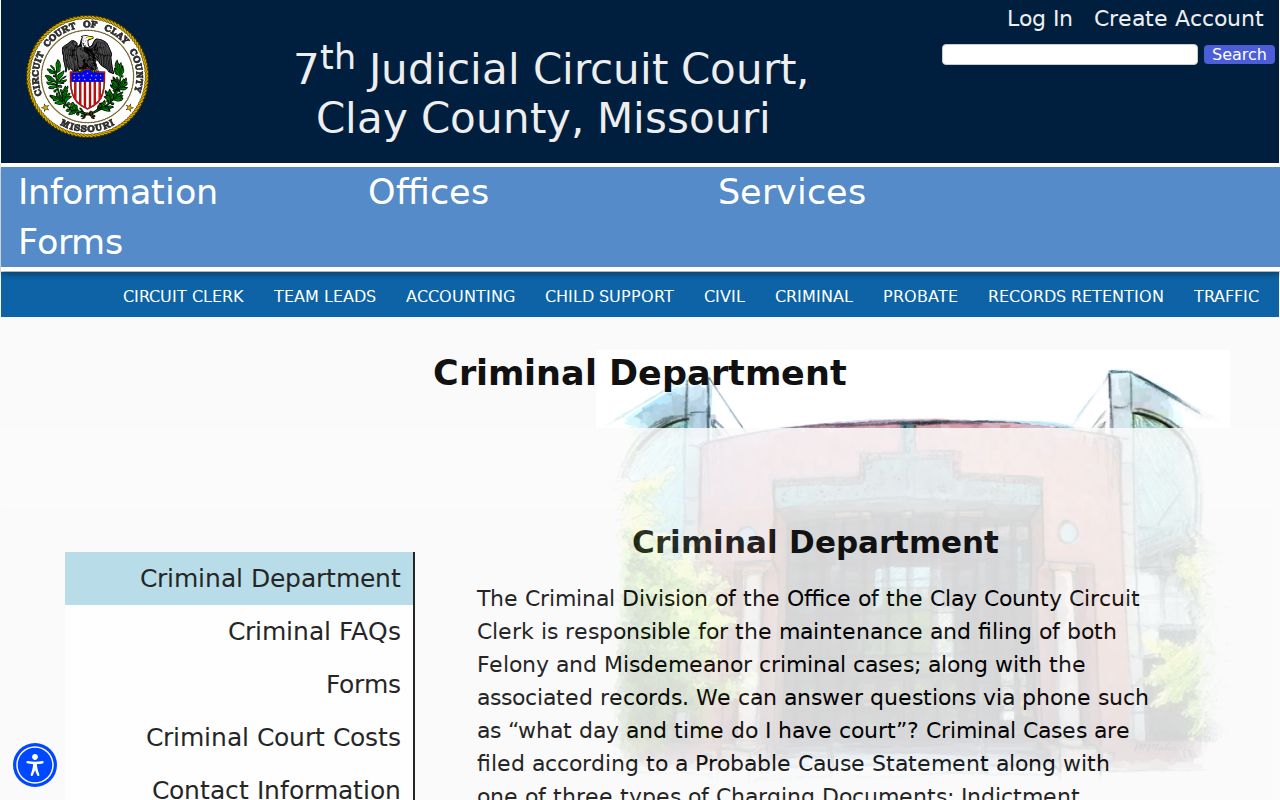
The official Criminal Division page spells out how the department separates its procedures from what a public docket search covers, from bond refunds to closed-document requests.
Sealed Dockets and Public Access
Missouri opens most docket information to the public but walls off certain court material. Closed criminal records stay off limits under RSMo 610.120. Missouri Court Operating Rules add their own treatment of confidential, sealed, and expunged files. So a case entry may appear in a docket search while its documents stay sealed. If an item is locked or unavailable, respect the restriction. Working around it is not an option.
Getting a closed record follows a narrower path. The Circuit Clerk FAQ and the Criminal Division set that path. You may need to be the subject, a party, or an attorney. Eligible closed-document requests can require a legible government ID. They can also require the pertinent case identifiers, destination information, and a notarized signature. Those details go only through the official request channel, never through a public docket search.
Clay County Criminal Docket Search Limits
A name search can come up empty for plenty of reasons. Protected names do it. So do victim and child protections, spelling variations, older files, or searching the wrong court level. Missouri law shields certain personal identifiers and victim information. Remember what a miss does not mean. No result does not prove the matter is absent, and a hit never authorizes copying private details. For an older record, a closed record, or a document with no online copy, go through the Circuit Clerk, the Criminal Division, or a courthouse terminal.
Sequence matters for older open public files. Start with Case.net. Then try a public terminal or a clerk inquiry. Follow the older-case fax instructions where the clerk points you. A closed criminal document is stricter, and the local request rules must be followed exactly. For a future setting, run the hearing search and the division schedule first. Confirm a close date through the court or your attorney. Keeping these channels apart stops a name search, a copy request, and a procedural question from blurring into one task.
For the Criminal Division, call 816-407-3860. That office is the right first stop. It publishes instructions on criminal records, missed court dates, address changes, bond procedures, and other Clay County criminal docket questions.