
Searching Clay County Civil Dockets
Missouri Case.net is the statewide public system behind most Clay civil docket research. Got a case number from a court notice or the clerk? Use Case Number Search first. With only a party name, search the legal name. Then confirm the category, filing date, division, and county before trusting a match. Filing Date Search suits a narrow time window. For a hearing coming up, try the Scheduled Hearings & Trials route, then open the case history for the fuller docket context.
When the court selector appears, pick Clay County and the 7th Judicial Circuit. Automated requests to Case.net return a 403 response. So rely on the live public form for exact dropdowns and fields rather than any guesswork. Note that a city ordinance matter and a Clay circuit civil case can take different routes. Both belong to the county.
| Search need | Official channel | Verification step |
|---|---|---|
| Known case | Case Number Search | Confirm circuit, division, filing date, and prefix. |
| Party search | Litigant Name Search | Protected family or child data can be withheld. |
| New filing period | Filing Date Search | Keep the range short and use a visible category filter. |
| Public filed document | Case header, Docket Entries, public link | Use a terminal or clerk request if no public link appears. |
Clay County Civil Docket Case Categories
The Clay Civil Division splits civil work by jurisdiction and type. Circuit civil cases generally top $25,000. They cover personal injury, eminent domain, declaratory judgment, temporary restraining orders, and expungement or correction of arrest records. Associate civil matters generally stay under $25,000. They include rent and possession, Department of Revenue disputes, replevin, foreign judgments, delinquent local tax, name changes, and collections. Domestic matters bring dissolution, paternity, modification, ex parte cases, and family access. Small claims carry a $5,000 limit and offer a money-judgment route, not property recovery.
Knowing the category tells you which kind of docket you are reading. It does not settle the status. For that, the case header and the exact court entry remain the source. The Civil Division page lays out the tracks. Circuit, associate, domestic, and small-claims all appear for Clay County.
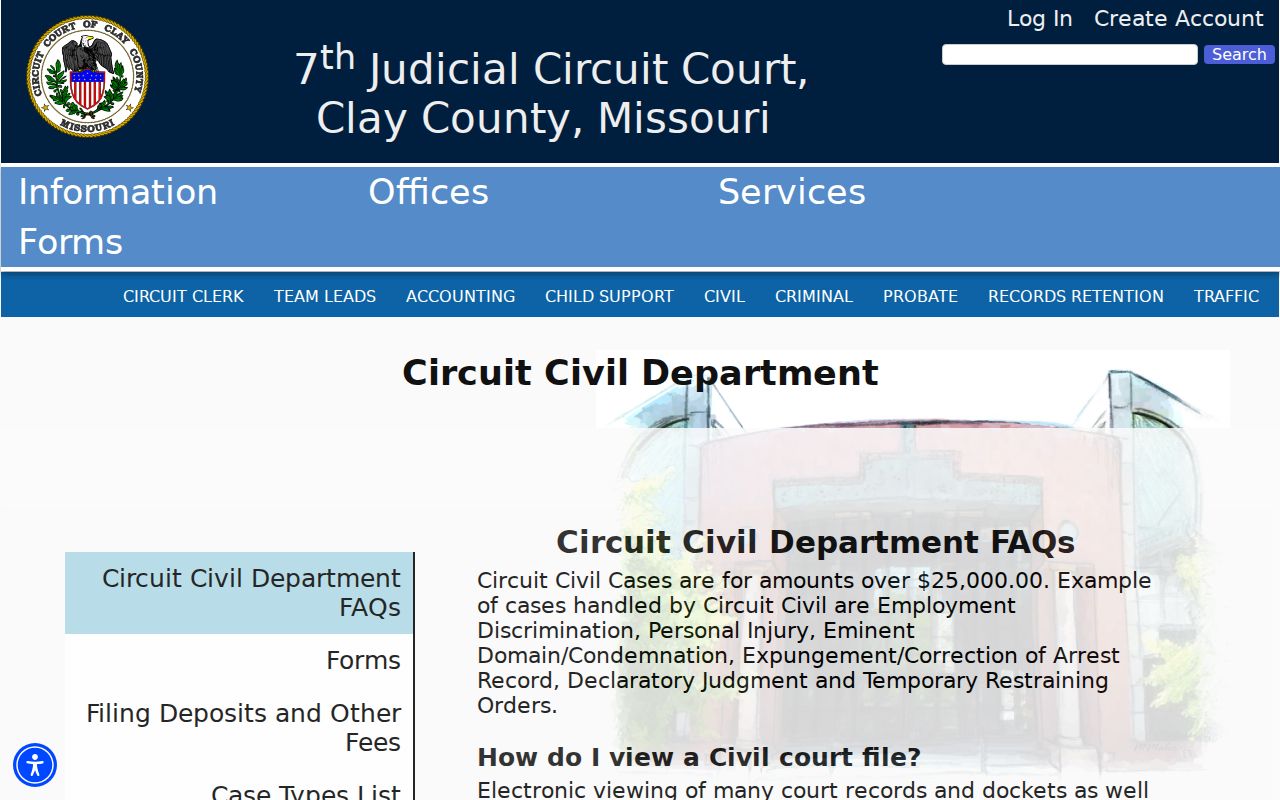
These official category descriptions serve a practical purpose. They help you pick the right Case.net route and spot when a local division follows different procedures.
Inside a Clay County Civil Docket
A public civil docket opens with the case header, then builds through dated entries. The safe field list stays basic. It covers circuit or county, category, case-type prefix, division, filing date, status, and the electronic-file indicator. Parties may appear as plaintiff and defendant or as petitioner and respondent. A chronological list follows. It can include a petition or complaint, service, an answer, motions, orders, pretrial activity, judgment, satisfaction, dismissal, or an appeal.
| Filing | Petition, complaint, or other initiating document and filing date. |
|---|---|
| Service and response | Service, answer, or related procedural entry. |
| Setting | Date, division, hearing type, and public remote or in-person label. |
| Order or judgment | The court action, distinct from the allegations in a filing. |
| Later status | Satisfaction, dismissal, transfer, appeal, modification, or another exact displayed entry. |
Clay County Civil Docket Prefixes as Search Clues
The Circuit Clerk's case-type list gives useful category clues without replacing the live portal. Domestic prefixes include Q and D. Protection categories include QA/DA, QB/DB, and QE/DE. Contract examples include CM/CA, CN/CB, CP/CD, and CQ/CE. The same list flags tort, real-estate, administrative, expungement, garnishee, judgment-debtor, and small-claims families. A prefix narrows the question nicely. Still, check it against the current case-type page. Then check the actual case record before you rely on it.
Resist building an unofficial codebook from prefixes alone. The portal may show current wording, and a case category never decides the merits. Weigh the header, division, filings, and later entries together. Only then describe what the docket shows.
Civil Case Types on the Docket
Civil tracks differ in value limits, subject matter, and access. Circuit civil and associate civil are jurisdictional categories. Domestic and protection matters can restrict a public search. Small claims run on their own simplified money-claim track. Knowing the broad category helps you search more accurately. It also lets you ask the clerk for a specific document instead of an undefined "whole file."
- Circuit civil
- Clay’s general civil track for matters generally exceeding $25,000.
- Associate civil
- Clay’s designated civil track for matters generally under $25,000 and listed associate work.
- Small claims
- A money-judgment route limited to $5,000, not property recovery.
- Petition
- A party’s filing that states allegations; it is not a court finding.
- Satisfaction
- A later entry that can show a judgment or obligation has been satisfied.
Clay County Civil Docket Small Claims and Mediation
Clay County runs its small-claims cases in Division IX. The Small Claims page for the Seventh Circuit sets the money-judgment cap at $5,000. It also points parties toward mediation. Local materials describe two free hours of mediation for eligible small-claims matters. Mediation is a process option, not an outcome. The civil docket is still where you confirm what actually happened. Filings, settings, orders, dismissals, judgments, and later satisfactions each get their own entry.
When you request a small-claims document, name the exact case. Name the docket entry you need. Copies come in three forms. An ordinary copy, a certified copy, and an authenticated copy are different products with different uses. The clerk can explain procedures and access. The clerk cannot advise you on a claim, a defense, or what an entry means.
Do not treat small claims as a compressed version of every other civil action. The Clay Civil Division calls it a limited money-judgment route. Circuit civil, associate civil, and domestic records each carry their own categories and procedures. Still, the reading sequence stays the same. Locate the header first. Check the case category and division. Read the filing and service entries early in the sequence. Only then treat any setting, order, dismissal, judgment, satisfaction, or de novo appeal as the current status. A mediation reference proves nothing. The Small Claims page mention does not show how a case ended, and a scheduled mediation or hearing never replaces the later docket entry. If an entry points to a public document, open it through the official route. When there is no public link, request the named document from the Clerk or inspect the available material at the courthouse. Never infer a result from the amount sought, the case prefix, or the Division IX assignment.
Civil Docket Settings and Hearings
A hearing is only a scheduled event. It is not a result. Case.net's scheduled-hearing route can help you find the next civil setting, but the later docket entry or the filed order tells you what actually occurred. Division II's official page lists civil work, trial days, pretrial work, pleas, and continuances. Division III covers family, domestic-violence, parenting, and routine family-motion settings. Write down the division, the date, the time, and the hearing type, then check later entries for a continuance, order, judgment, or new setting. For a date-specific workflow, see Clay County Court Dates. When a setting is close, changed, or unclear, confirm it directly through the court notice, your attorney, or the clerk.
Clay County Civil Docket Documents Without Online Images
Sometimes a docket entry shows an order but the document itself stays closed online. That gap is common. The Missouri File Viewer guidance says public electronic documents open only through the permitted route. So the missing image can stem from remote-release limits. It might instead be confidentiality, a sealed category, or a file that simply has not been digitized. It does not mean the court never got the document.
When Case.net falls short, the Circuit Clerk FAQ offers an older-case request channel as a backup. You can also stop at the courthouse public terminal. Or call the clerk for one precise document. Bring the case number, the docket date or item, and the copy type you want. That works far better than asking staff to run an open-ended investigation of the facts.
Dates matter in Clay County. The county's public-access page traces civil records back to 1978. Older files may still lack online images. For anything predating the July 1, 2023 remote-document change, the public terminal or a clerk request may still be your best route. That holds even when the docket itself is easy to search. Keep four things straight: an entry, a document image, a certified copy, and a transcript. Each one takes a different path to get.
Civil Docket Access Rules
Missouri court rules and record restrictions govern public access. A civil case can hold public metadata and public filings. Material that stays closed can sit right beside them. Withheld items include confidential filing sheets. They also include protected personal information, records involving minors, protected victim identifiers, and anything sealed by law, rule, or order. RSMo 509.520 identifies the information requiring redaction or confidential treatment. Domestic, family, child, and protection matters may carry additional limits.
Read access limits literally: a visible docket entry is not a promise that an attachment is public.
For an access question, use the Circuit Clerk or the court. For legal interpretation of a civil claim or order, consult a licensed attorney.
Clay County Civil Docket Fees and Copy Requests
Clay's circuit fee schedule took effect August 28, 2023. It keeps filing fees and copy fees separate. Regular circuit petitions run $105.50. Domestic relations petitions cost $137.50 without children and $197.50 with children. Stipulated modifications are $39. Small claims are $20.50 plus applicable postage. Associate filings generally run $33.50. Treat none of those figures as a promise of a current charge. Confirm the live schedule and the proper category before you file or request service.
| Copy type | Amount located | Use |
|---|---|---|
| Ordinary photocopy | $1 per page | Standard copy request |
| Certified copy | $4 first page; $1 each additional | Clerk certification requested |
| Authenticated copy | $6 first page; $1 each additional | Authentication procedure requested |
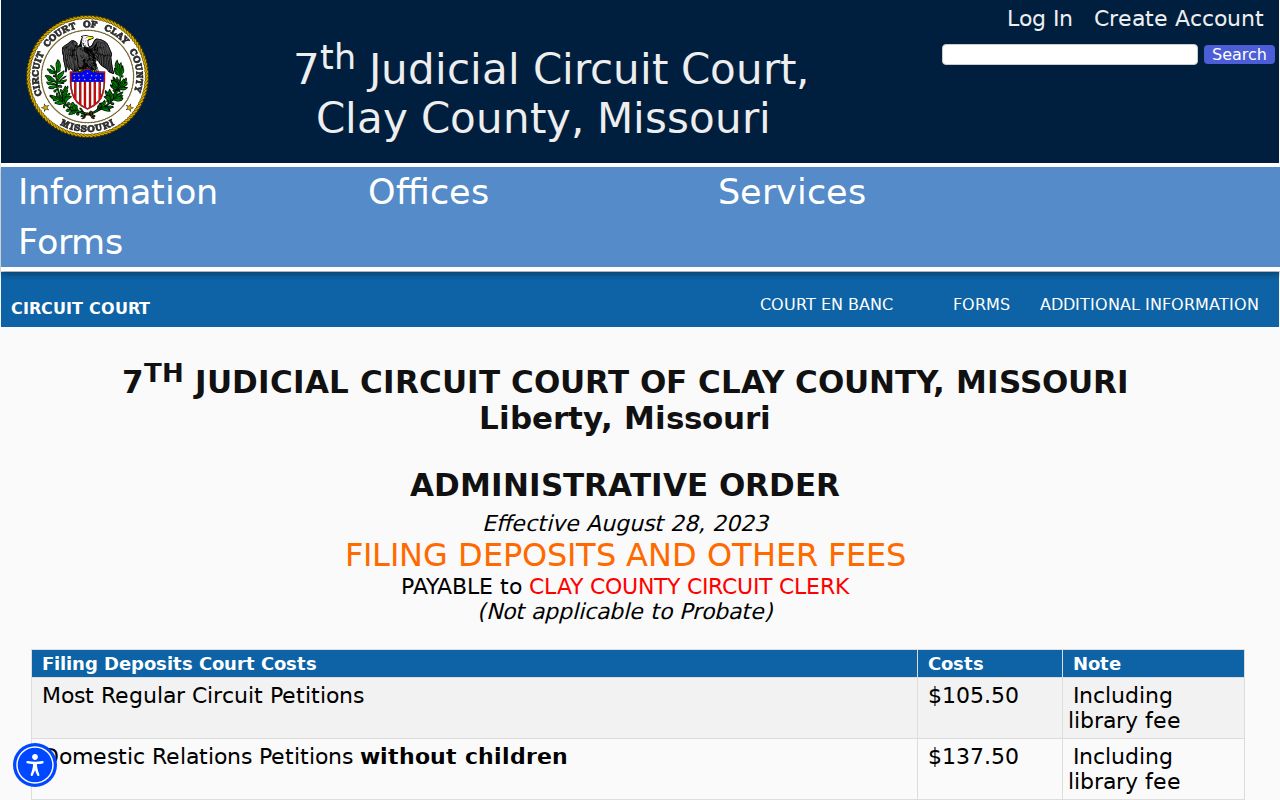
Check the official fee table when you make your request. Court costs and procedures can change. The local rules add that interested parties may obtain copies of nonconfidential files from the Circuit Clerk. They also spell out when certain county or state departments, along with qualifying in-forma-pauperis parties, receive attested, certified, or authenticated copies without charge. Everyone else should rely on the current fee schedule. Ask for the specific case document you need. Don't assume a filing charge covers a later copy.